What Is Your One-Rep Max and How Do You Calculate It?
Estimate your one-rep max using Epley and Brzycki, understand training percentages, and plan strength workouts without unnecessary maximal lifting.
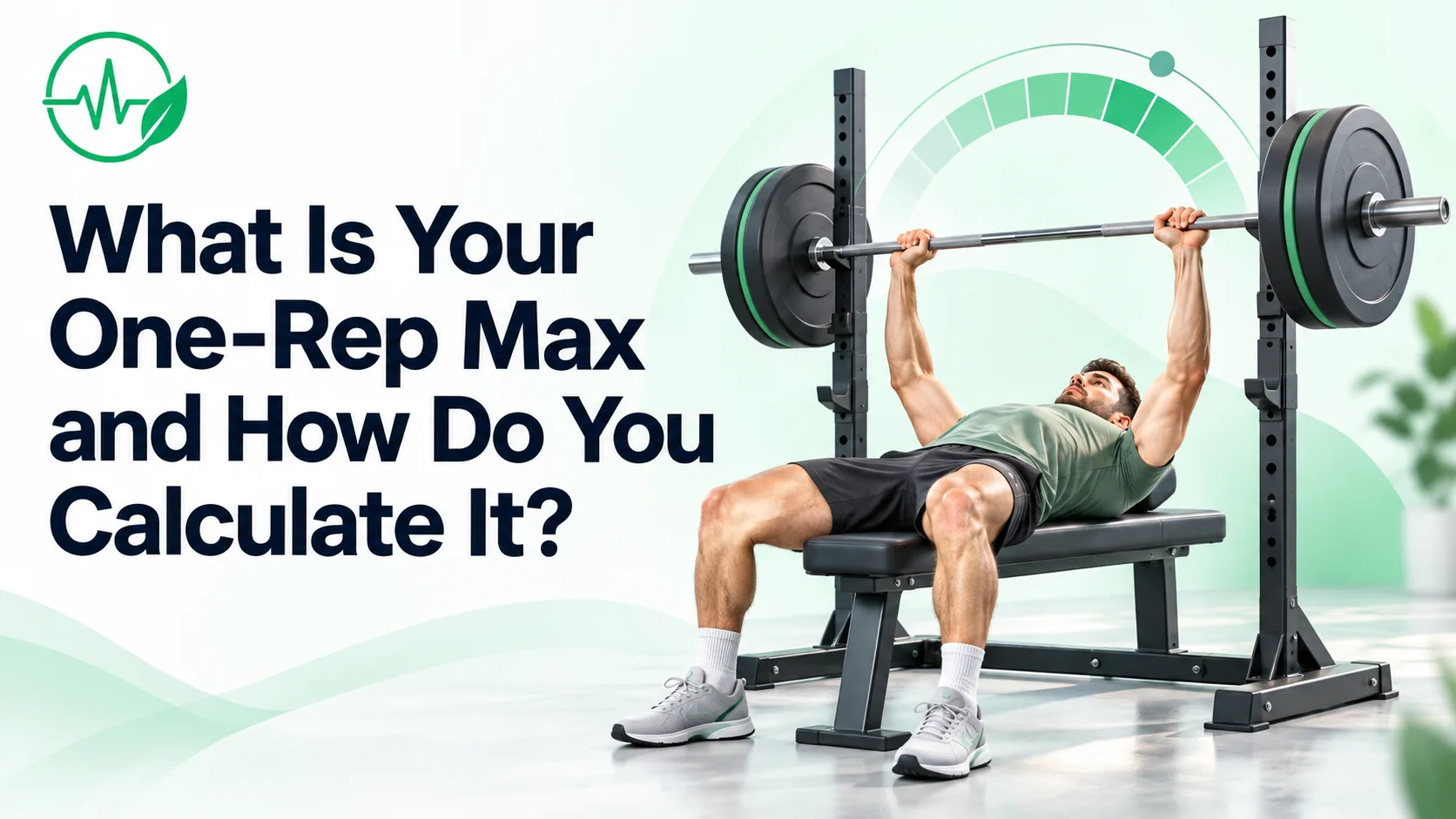
Your one-repetition maximum (1RM) is the heaviest load you can lift once with controlled technique in a particular exercise. You do not need to attempt an all-out lift to estimate it: a challenging, well-performed set with a lighter weight can provide a useful prediction [1][2]. Enter the weight and completed repetitions into the One-Rep Max Calculator to compare Epley and Brzycki estimates and view suggested percentage-based training loads. The result is a planning tool, not a guarantee that you can safely lift the predicted maximum.
What does a one-rep max actually measure?
A measured 1RM describes maximal strength in one specific movement under specific conditions. Bench press, squat, deadlift, and overhead press have different 1RM values; a strong result in one does not transfer numerically to another. Technique, equipment, range of motion, fatigue, and familiarity with the lift all affect performance [2][3]. An estimated 1RM is a mathematical projection from a submaximal set, whereas a tested 1RM is a weight actually completed for one technically acceptable repetition. Neither number alone determines overall fitness or cardiovascular health.
How do the Epley and Brzycki formulas calculate 1RM?
The Epley equation is estimated 1RM = lifted weight x (1 + repetitions / 30). The Brzycki equation is estimated 1RM = lifted weight x 36 / (37 - repetitions). Both use a weight you successfully lifted multiple times to predict a single-repetition maximum, but their assumptions differ [1][2]. Use pounds or kilograms consistently; the result uses the same unit. These formulas are most useful for relatively low-repetition sets performed close to technical failure, not for very long endurance sets.
How much is your 1RM if you lift 176 pounds for five reps?
Consider a hypothetical lifter who completes five controlled repetitions with 80 kg (about 176.4 lb). Epley predicts 80 x (1 + 5 / 30) = 93.3 kg (205.7 lb). Brzycki predicts 80 x 36 / (37 - 5) = 90.0 kg (198.4 lb). The values differ by 3.3 kg (7.3 lb), illustrating why a calculator offers estimates rather than a measured maximum. If this was a comfortable set with several repetitions left in reserve, both formulas could underestimate what the lifter might do after a properly prepared maximal attempt [1][2].
| Method | Calculation | Estimated 1RM |
|---|---|---|
| Epley | 80 x (1 + 5 / 30) | 93.3 kg (205.7 lb) |
| Brzycki | 80 x 36 / 32 | 90.0 kg (198.4 lb) |
| Difference | 93.3 - 90.0 | 3.3 kg (7.3 lb) |
Worked 1RM example: an 80 kg lift performed for five repetitions
What do 50%, 70%, 80%, and 90% of your 1RM mean?
A percentage of 1RM expresses a training load relative to your predicted single-repetition maximum. For example, 80% of an estimated 93.3 kg maximum is about 74.7 kg (164.6 lb). Lower percentages often permit more repetitions, while higher percentages generally demand greater strength and fewer repetitions, but actual repetition capacity varies by person and exercise [3]. The calculator supplies a percentage table, not mandatory weights or an individualized prescription. The Strength Program Builder can turn a cautious estimate into a progressive training outline when you already have sound lifting technique.
| Percent of 1RM | Approximate load | How to interpret it |
|---|---|---|
| 50% | 46.7 kg (103 lb) | Lighter practice or warm-up load |
| 60% | 56.0 kg (123 lb) | Moderate relative load |
| 70% | 65.3 kg (144 lb) | Moderately challenging load |
| 80% | 74.7 kg (165 lb) | Higher-intensity working load |
| 90% | 84.0 kg (185 lb) | Heavy load; advanced preparation matters |
Illustrative training loads based on an Epley-estimated 1RM of 93.3 kg
How many repetitions give the most useful 1RM estimate?
A technically consistent set of about three to six repetitions is a practical starting point for many trained adults. Prediction uncertainty usually increases as the set becomes longer, especially when muscular endurance rather than maximal strength begins to dominate [1][2]. A set of 15 to 20 repetitions should not be treated as equally informative as a controlled low-rep set. Beginners do not need to train to failure just to feed the calculator; learning movement technique and using appropriately conservative loads come first. A repetition with shortened range or major compensations should not count as an equivalent full rep.
Why do Epley and Brzycki show different results?
The two equations approximate the load-repetition relationship differently, so their predictions diverge at some repetition counts. At ten reps they coincide mathematically, while for a five-rep set Epley gives a somewhat higher prediction. Differences do not mean one formula has identified your true maximum: published research shows that exercise selection, repetitions completed, training background, and individual characteristics influence accuracy [1][2]. If the estimates disagree, treat the spread as a reminder of uncertainty and avoid selecting an aggressive load simply because the higher formula produced it.
Can you compare one-rep max across exercises or equipment?
Only with considerable caution. A barbell bench press, a dumbbell press, and a chest-press machine use different stabilization demands and loading conventions; each needs its own baseline. Record whether the number represents total barbell weight, the load in each hand, or a machine's marked stack. Two gyms may also have different machines or available weight increments. Bodyweight endurance testing asks a different question: the Push-Up Test Calculator measures repeated pressing performance rather than estimating the heaviest possible barbell repetition. Progress is clearest when you repeat the same lift with the same technique and equipment [2][3].
How can you use estimated 1RM without testing a true max?
Choose a recent, challenging set you completed with consistent form; record its exercise, load, and repetitions. Use the lower of two estimates when a conservative starting point makes sense, then begin with a weight you can move with control. A measured 1RM can be repeatable under standardized supervision, but a maximal test is not necessary for most recreational training [2]. Reassess your estimated 1RM after several weeks of consistent training rather than chasing a record at every session. Use the Recovery Time Calculator to review training-rest considerations, while remembering that a recovery estimate does not establish medical readiness.
How do you improve your estimated 1RM safely over time?
Progressive resistance training builds strength by gradually changing load, volume, or the demands of an exercise while preserving technique and recovery [3]. For most adults, exercising major muscle groups at least two days each week is consistent with CDC physical activity guidance [4]. Begin below maximal effort, use appropriate warm-up sets, and increase weight in small steps only when repetitions remain controlled. Proper nutrition also matters; the Protein Intake Calculator can provide an educational estimate, while How to Keep Muscle While Losing Weight explains how resistance training fits into body-composition goals.
For perspective, an improving 1RM estimate may reflect better technique, coordination, greater skill at a particular lift, and increased force production, not necessarily new muscle alone. Our lean body mass guide explains why fat-free mass and strength are different measurements. Keep a training log and look for repeatable progress under comparable conditions rather than defining success by the largest number on one day.
When is a one-rep max estimate misleading or unsafe to use?
The equations become less dependable with high-repetition sets, inconsistent technique, unusually long pauses, limited range of motion, or exercises unlike those used to study the formulas [1][2]. Recent injuries, surgery, severe pain, unstable joints, cardiovascular symptoms, and medical restrictions are reasons not to use a calculator's number as permission for heavy lifting. A qualified coach or rehabilitation clinician may recommend submaximal alternatives or a supervised assessment. An estimated 1RM is a mathematical training aid; it cannot diagnose weakness, determine injury risk, or clear someone for maximal exertion.
When to Seek Medical Care Do not attempt a true maximum lift if you are inexperienced, injured, recovering from surgery, or medically restricted without appropriate professional guidance. Stop immediately for chest pain, faintness, unusual breathlessness, sudden weakness, or sharp joint or muscle pain. Seek emergency care for concerning chest symptoms or collapse. Use a spotter or properly set safety bars for heavy free-weight attempts. This calculator is educational only and cannot certify that a predicted weight is safe to lift [3][4].
People also ask
Is a 225-pound bench press a good one-rep max?
A 225-pound bench press can represent very different levels of performance depending on body size, training experience, age, and the rules of the lift. There is no universal medical threshold for a good 1RM. Compare your result primarily with your own previous lifts performed using the same technique and equipment. A larger maximum alone does not establish overall fitness or health [2][3].
Do I need to lift my true maximum to use this calculator?
No. The purpose of an estimated-1RM calculator is to use a completed submaximal set instead of requiring a maximal attempt. Enter the actual weight lifted and the number of sound repetitions performed, ideally from a relatively low-rep working set. The output may be useful for planning, but a prediction is not proof you could safely perform the calculated one-rep lift [1][2].
How often should I update my one-rep max estimate?
For many recreational lifters, recalculating every four to six weeks or after a meaningful change in working-set performance is practical. This interval is a training habit rather than a medically required schedule. Use comparable exercises, rest, warm-ups, and technique each time. If you are fatigued, ill, or returning from injury, postponing a demanding assessment is more sensible than forcing a new number [2][3].
Does the calculator work for dumbbells and machines?
The equations can produce a mathematical estimate from a load and repetition count, but that does not make the results equally accurate for every movement. Clearly record whether a dumbbell load refers to one hand or both and avoid comparing it directly with barbell weight. Machine design and cable ratios also vary. Track the same exercise and equipment rather than transferring a predicted maximum between them [1][2].
What if I stop my set with two repetitions left in reserve?
A set stopped before technical failure may lead to an estimated 1RM below your actual capacity, because many prediction formulas were evaluated with repetitions-to-fatigue protocols. Do not automatically add two repetitions to the input and treat that as a validated correction. Record the repetitions you completed, note the estimated reserve separately, and interpret the result conservatively. You can improve the estimate through consistent training records rather than an unsafe all-out attempt [1][2].
Sources
- The Accuracy of Prediction Equations for Estimating 1-RM Performance in the Bench Press, Squat, and Deadlift — Journal of Strength and Conditioning Research (1997)
- Test–Retest Reliability of the One-Repetition Maximum Strength Assessment: A Systematic Review — Sports Medicine - Open (2020)
- Progression Models in Resistance Training for Healthy Adults — American College of Sports Medicine (2009)
- What You Can Do to Meet Physical Activity Recommendations — Centers for Disease Control and Prevention (2025)
- Muscular Endurance Repetitions to Predict Bench Press Strength in Men of Different Training Levels — PubMed (1995)